Categories:
Brisbane researchers are developing a game-changing new immunotherapy designed to cross the blood-brain barrier and destroy one of the most aggressive and lethal forms of breast cancer.
Triple-Negative Breast Cancer (TNBC) accounts for up to 20 per cent of all breast cancer cases and frequently affects younger women. Nearly half (46 per cent) of the advanced cases will also see the cancer spread to the brain - dropping survival rates to less than six months.
Brisbane mum, Vivian Crick, was diagnosed with metastatic breast cancer at age 44.
"A breast cancer diagnosis can feel like a full stop to life," said Ms Crick.
"It was a total shock – you are suddenly devastated and have no certainty about what the future is.
"I had a big life, full-time job, raising five kids – suddenly you're then wandering through a world that's completely different and you can't go back to how it was.
"My original prognosis wasn't good - the metastases are in my bones."
Ms Crick has undergone multiple treatments, surgery, chemo and radiation and has just ticked over 10 years since her diagnosis. She has continued to be involved with the work at Mater research during her journey.
"Knowing that there is a team around you that are working really hard for the next thing, keeps you going," Ms Crick said.
Treating this type of cancer spread has been complicated because the brain’s natural protective shield does not allow standard chemotherapy and targeted drugs to cross the blood-brain barrier.
However, thanks to a $500,000 Pink Sky Grant from the National Breast Cancer Foundation (NBCF), a collaborative team from Mater Research and QIMR Berghofer is pioneering a world-first solution - a biological "Trojan Horse."
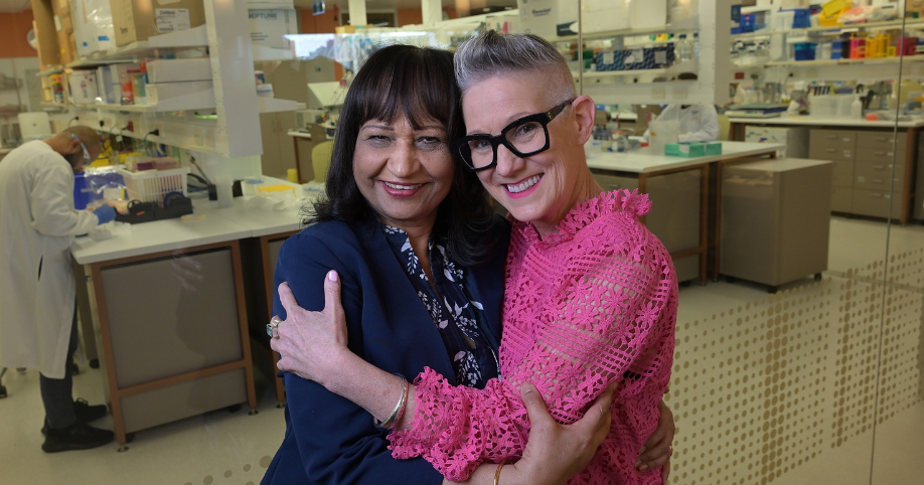
The research is led by Professors Kum Kum Khanna and Rajiv Khanna OA, who bring together complementary expertise in cancer biology and immunology.
Professor Kum Kum Khanna said that for too long, a diagnosis of TNBC spreading to the brain has come with a devastating prognosis.
"We are losing too many young women and mothers because our current drugs simply cannot penetrate the brain's natural shields,” she said.
“This research is about changing that narrative.
“We are giving the immune system the exact coordinates to hunt down these tumours where they hide."
The groundbreaking research focuses on Cytomegalovirus (CMV)-specific T cells, which, unlike standard immune cells, naturally possess the unique ability to safely cross the blood-brain barrier and survive longterm without exhaustion.
Through using cutting-edge Chimeric Antigen Receptor (CAR) technology, the researchers are genetically engineering these brain-penetrating immune cells to specifically hunt down "Trop2"—a protein highly expressed on the surface of TNBC tumours.
Professor Rajiv Khanna said their aim is to essentially create a living drug.
"By taking a resilient, virus-fighting immune cell that already knows how to slip past the blood-brain barrier, and arming it with a cancer-seeking receptor, we are developing a highly targeted weapon," Professor Rajiv Khanna said.
“This could completely redefine how we treat solid tumours in immune-privileged environments like the brain."
The three-year project aims to generate the critical preclinical data required to move the therapy into human clinical trials. If successful, it would represent the first effective cell-based therapy for breast cancer brain metastases.
October marks Breast Cancer Awareness Month, and NBCF CEO, Dr Cleola Anderiesz highlighted the importance of the new Pink Sky Grant Scheme.
“The Pink Sky Grant Scheme supports novel research projects with paradigm-shifting potential to revolutionise approaches to combating breast cancer and ultimately brings us closer to realising our vision of Zero Deaths from breast cancer.
“The impact of research funding is measured not only by today's discoveries, but by the breakthroughs they enable tomorrow. Every major advancement in breast cancer prevention, detection and treatment started as an idea. By backing innovative researchers today, Pink Sky Grants are helping to build the pipeline of discoveries that have the potential to improve outcomes and ultimately save lives from breast cancer in the years ahead.”
Professor Kum Kum Khanna is a cancer biologist who leads Mater Research’s Tumour Biology Research Group, while Professor Rajiv Khanna is an immunologist who leads QIMR Berghofer’s Tumour Immunology Laboratory. The pair have a long personal and academic connection, having trained together at the same institute and been married for 37 years.