
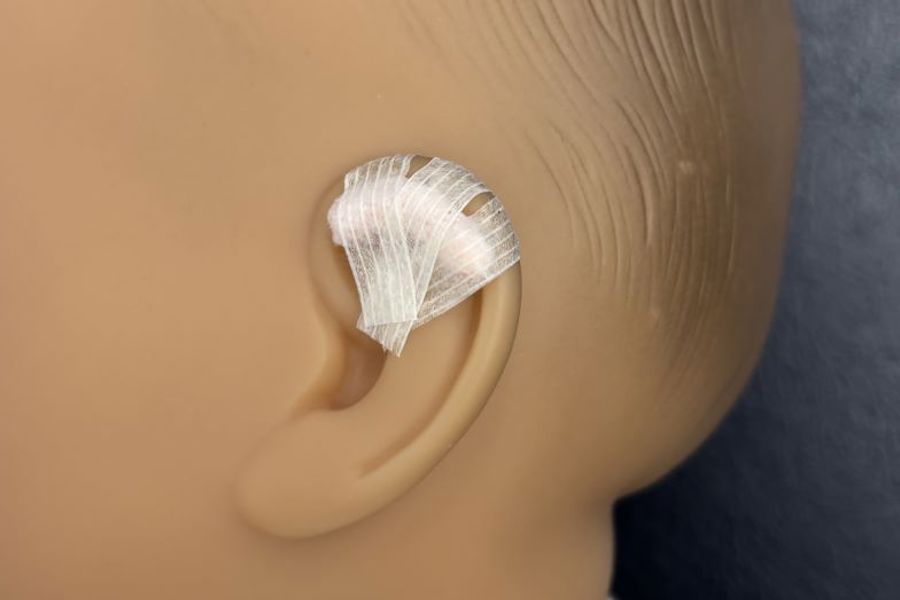
Concerned about the shape of your baby’s ear?
Ear shape differences can occur in newborn babies and are often noticed shortly after birth. This may look like:
- A fold in the ear
- Ears that sit slightly forward
- A tighter or curved ear shape
These differences are common and usually do not affect hearing.
The good news

There is a simple, non-invasive option called ear splinting.
A soft splint gently guides your baby’s ear into a more typical shape while the cartilage is still soft.
- Safe and gentle
- No surgery needed
- Can be highly effective when initiated early
In many cases, early assessment and treatment can lead to excellent outcomes. [1]
Why timing matters

Ear splinting works best when started in the first six weeks after birth.
During this time:
- The ear is soft and easy to reshape
- Treatment is quicker and more effective
Treatment can still be done later, however may take longer. [2]
Why consider ear splinting?

While ear shape differences don’t usually affect hearing, early treatment may:
- Improve ear shape
- Help to avoid surgery later in childhood
- May reduce future concerns about appearance or self-confidence
An occupational therapist can assess whether ear splinting may be suitable for your baby.
How long will your baby wear their splint?

Most babies wear their splint for around four to six weeks.
Treatment time may vary depending on how quickly the ear shape changes and how old the baby is. [3]
For more information
Phone: 07 3163 6000
First prompt: 1, Second prompt: 1
Email: info.childrenswellness@mater.org.au
Address:
Level 3, Salmon Building
Cnr Raymond Terrace and Stanley Street, South Brisbane, Qld 4101
[1] Koshy, K., Radha, K. S. E. S., Koshy, G., Scurrah, R., Sainsbury, D. C. G., & Sriram, S. (2025). Ear splinting for ear anomalies in infants: Is it worth doing and have we missed the boat? A prospective, cohort study. Journal of Plastic, Reconstructive & Aesthetic Surgery, 103, 157–167.
[2] Andreas, R., Anggadinata, P. L., Arifin, B. J., Najmi, N., & Syawqie, A. (2023). Literature review: Rehabilitation of ear congenital abnormalities. European Journal of Theoretical and Applied Sciences, 1(3), 191–195.
[3] Chang, Y., & Chen, L. (2024). Nonsurgical correction of congenital auricular anomalies: Design and effectiveness of the ear splint. Plastic and Reconstructive Surgery – Global Open, 12(7), e5961.