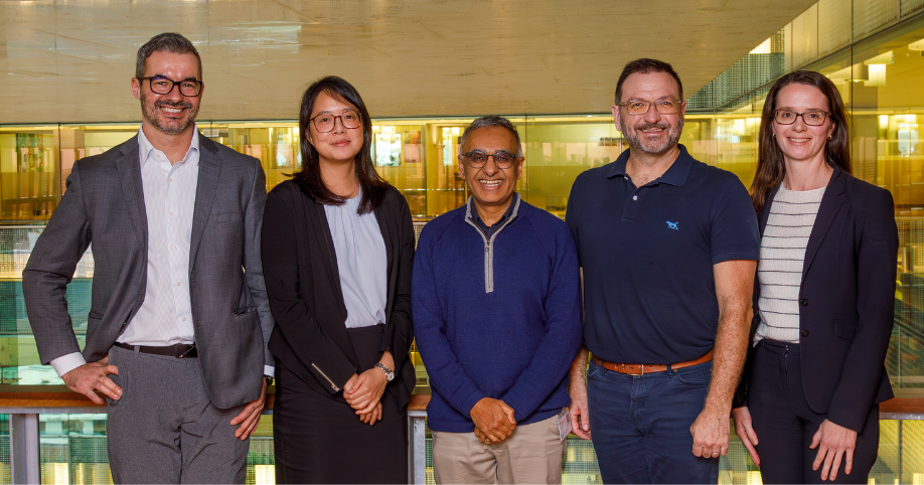
A consortium led by Professor Maher Gandhi has secured nearly $4 million from the Medical Research Future Fund (MRFF) to create a “next-generation” leukaemia therapy, providing a lifeline for older patients who have run out of survival options.
In a unique “whole of translational research” effort, the project unites experts from all partners at Translational Research Institute (TRI) — Mater Research, The University of Queensland (UQ), Queensland University of Technology (QUT) and Metro South Health — leveraging Brisbane’s innovation precinct and TRI’s cutting-edge core facilities to bring the treatment from the lab directly to the clinic.
The project aims to treat Acute Myeloid Leukaemia (AML), an aggressive cancer that is most common in adults, particularly those over 60 years old. While current Chimeric Antigen Receptor (CAR-T) therapy has advanced the treatment of other blood cancers, current CAR-T must be individually manufactured from a patient’s own cells, a highly personalised process involving shipping cells to the US or Europe, which takes several weeks.
For older AML patients, their immune systems are often heavily pre-treated and simply too weak to be harvested for this treatment.
To overcome this, the new project will create “off-the-shelf” doses using genetically engineered immune cells derived from umbilical cord blood. These highly potent cells will be frozen and ready for immediate use in hospitals nationwide.
Research lead, TRI CEO Professor Maher Gandhi, who leads the Blood Cancer Research Group at Mater Research, said this therapy is about more than just a new drug.
“We are moving towards a model where high-tech cell therapy isn’t a bespoke luxury item, but a scalable, accessible product manufactured right here in Brisbane,” Professor Gandhi said.
“Time is the one thing these patients don’t have, and currently, we lose people during the weeks it takes to manufacture a bespoke dose, or the therapy fails because an older patient’s immune system is simply too exhausted to fight.
“This new therapy changes the equation. By using ‘young’, highly potent cord blood cells that are frozen and ready on demand, we can offer an instant lifeline the moment a patient relapses.”
Donated cord blood will be provided by the Queensland Cord Blood Bank at Mater Mothers’ Hospital Brisbane. Director Phillip Johnson highlighted the profound human element of the project.
“This entire breakthrough relies on the goodwill and compassion of expectant mothers and their partners, agreeing to donate their baby’s umbilical cord blood after birth,” Mr Johnson said.
“These families, through their generosity, are quite literally providing the building blocks to save the lives of people they will never meet.”
Associate Professor Fernando Guimaraes from UQ’s Frazer Institute is coordinating the complex manufacturing process using TRI’s specialised T3 cleanroom facilities.
“We are taking specific immune cells from these cord blood units and engineering them with precise genetic instructions to find and destroy leukaemia cells,” Associate Professor Guimaraes said.
“Conducting this within TRI’s cleanrooms means we can manufacture clinical-grade cell therapies locally, ensuring Australian patients have secure and rapid access without relying on international supply chains.”
Before reaching patients, the therapy undergoes rigorous testing led by Professor Laura Bray at QUT. Professor Bray said that to ensure the engineered T-cells are both safe and effective, they are tested against advanced 3D organoids, miniature, lab-grown models of human bone marrow.
“This allows us to prove the cells will obliterate the leukaemia without harming healthy tissue before they ever enter a clinical trial,” Professor Bray said.
The funded project introduces a novel technology called CCR-T that will expand umbilical cord blood. Developed in partnership with German biotech company Miltenyi Biotec, a globally active leader in cell and gene therapy, this technology incorporates a dual-targeting mechanism.
Clinical lead and haematologist Dr Victoria Ling, from the Princess Alexandra Hospital, said that for patients fighting aggressive AML that has not responded to standard therapies, there are limited other treatment options.
“The approach being undertaken is like boosting a patient’s immune system with a therapy designed specifically against their leukaemia, amplifying their capacity to fight the cancer,” Dr Ling said.
Leukaemia Foundation’s Head of Research Bill Stavreski said for people with acute myeloid leukaemia whose disease has returned, treatment options are often limited. Research like this offers hope for faster, more accessible therapies and better outcomes for people living with blood cancer.
The project will soon move to a Phase I national clinical trial that will test 15 patients with relapsed/refractory AML who have exhausted all other options and are resistant to standard therapies.
The project is a collaboration between TRI, Mater Research, UQ, QUT, University of Sydney, University of Melbourne, University of Technology Sydney, University of New South Wales, Australasian Leukaemia Lymphoma Group (ALLG), Leukaemia Foundation, Miltenyi Biotec and major hospitals across Queensland, Victoria, New South Wales, South Australia and Western Australia.