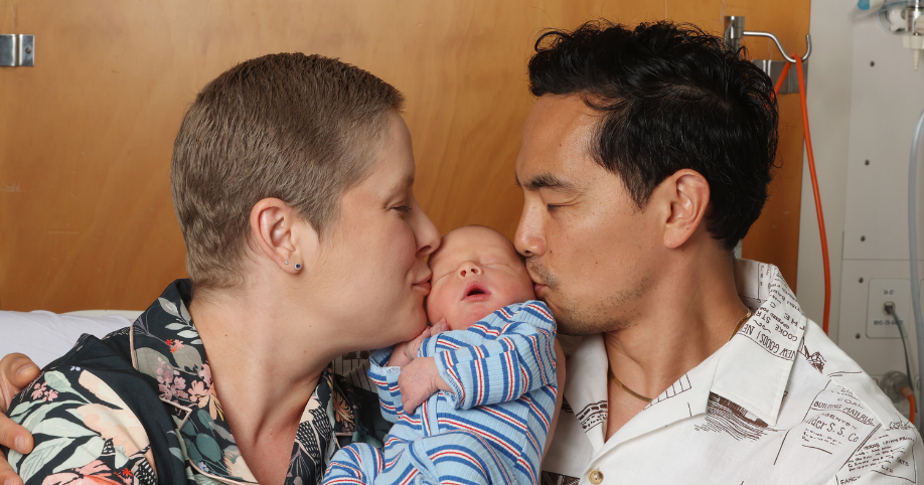
Learning she was pregnant with her first baby should have been the happiest day of Emma Haig’s life, but her joy was short-lived.
After getting a lump in her breast checked the 35-year-old was diagnosed with triple negative breast cancer – one of the most aggressive forms of the disease.
Thanks to the expert combined care of Mater oncologists and obstetricians, Ms Haig this month gave birth to a beautiful and healthy baby boy, Mason.
But her journey into motherhood will now coincide with the next stage of her cancer journey – undergoing gruelling rounds of chemotherapy in a bid to kill all trace of her breast cancer.
“I found out I was pregnant and found a lump in my breast the same day,” said Ms Haig.
“I almost dismissed the lump as part of pregnancy because there are already so many changes – but it did feel different though, so I thought I’d get it checked.”
Her diagnosis came as a shock as Ms Haig had no family history of the disease.
“I knew enough about this type of breast cancer to take it seriously,” she said.
“It was really hard to enjoy the joy of pregnancy because it quickly became a cancer journey.
“I had a lumpectomy in the first trimester and then had to wait until the second to start any other treatment – so there was a period of time where I knew I had this aggressive cancer but I couldn’t do anything.
“I’ve since been through eleven rounds of chemo.”
At 37 weeks Ms Haig welcomed a healthy baby boy, Mason, into the world, via a planned caesarean at the Mater Mothers’ Hospital.
“I’m so relieved to have Mason here,” said Ms Haig.
“Whilst I was reassured with my care during pregnancy, I was worried that there would be additional complications when he arrived but he is healthy and perfect.
“We are so happy and in love.”
Breast cancer diagnosed before 30 weeks gestation is generally managed with surgical and systemic cancer care and a planned preterm birth. Treatment for those diagnosed 30 weeks and beyond is postponed to after birth.
While being cared for by the Mater Cancer Care Centre Ms Haig has also been monitored by the Mater Mothers’ Centre for Maternal Fetal Medicine – which provides specialised management of complex obstetric cases.
“Being considered high risk I had additional scans and tests throughout my pregnancy but bub was tracking well,” she said.
“I’ve been consistently monitored by both teams and have felt extremely supported every step of the way.
“I will resume treatment in a few weeks – I can start radiation and get a PET scan now that I’m no longer pregnant.”
While breast cancer is the most common cancer diagnosed during pregnancy, it is rare – occurring in 1 in every 4,000 pregnancies and more prominent in women aged 32-38 years.
Mater Breast Surgeon Dr Susan Bell says it can be difficult for expecting women to pick up on symptoms.
“A breast cancer diagnosis is probably not the first thing that comes to mind,” said Dr Bell.
“During pregnancy your breasts change quite a lot, so sometimes a symptom which is actually a symptom of breast cancer can be seen as a normal change and not investigated.
“Because you're already getting more lumpy breasts or more firmer breasts, it can be seen as a pregnancy change - may assume it is a blocked duct or mastitis.
“It's not so much that the symptoms are different, but they could be more hidden, misunderstood or misinterpreted.
“My advice is if you feel like something isn't quite right - get it investigated, rule it out.”
This Breast Cancer Awareness Month all women are being encouraged to start getting to know their breasts with regular checks – even in the shower.
“Breast awareness is very important, and I think it should start early - even 20-year-olds should do regular breast examinations to understand what's normal for them and what's not,” Dr Bell said.
“Any lump should be investigated – but there are other symptoms like nipple discharge, especially if it's bloody and comes out spontaneously, if the nipple is drawn in or there are some changes where the skin is puckering or anything that doesn't feel normal.
“You know life gets in the way or things happen but for any breast cancer the earlier you find it, the better the treatment will be.”
Ms Haig’s cancer was not clear on a mammogram, it was during an ultrasound where the diagnosis was confirmed. Specialists say they’ve recently shifted their focus to breast density and the impact it can have on discovering cancer.
“It’s important to know your breast density,” said Dr Bell.
“It is one of the risk factors for breast cancer – can just make it harder to spot.
“A mammogram alone might not be sufficient for you, you might need some supplemental screening – and that’s something to be aware of.”